

After years of loyal service, my laptop groans when I open Outlook, Canva and Claude Code at the same time.
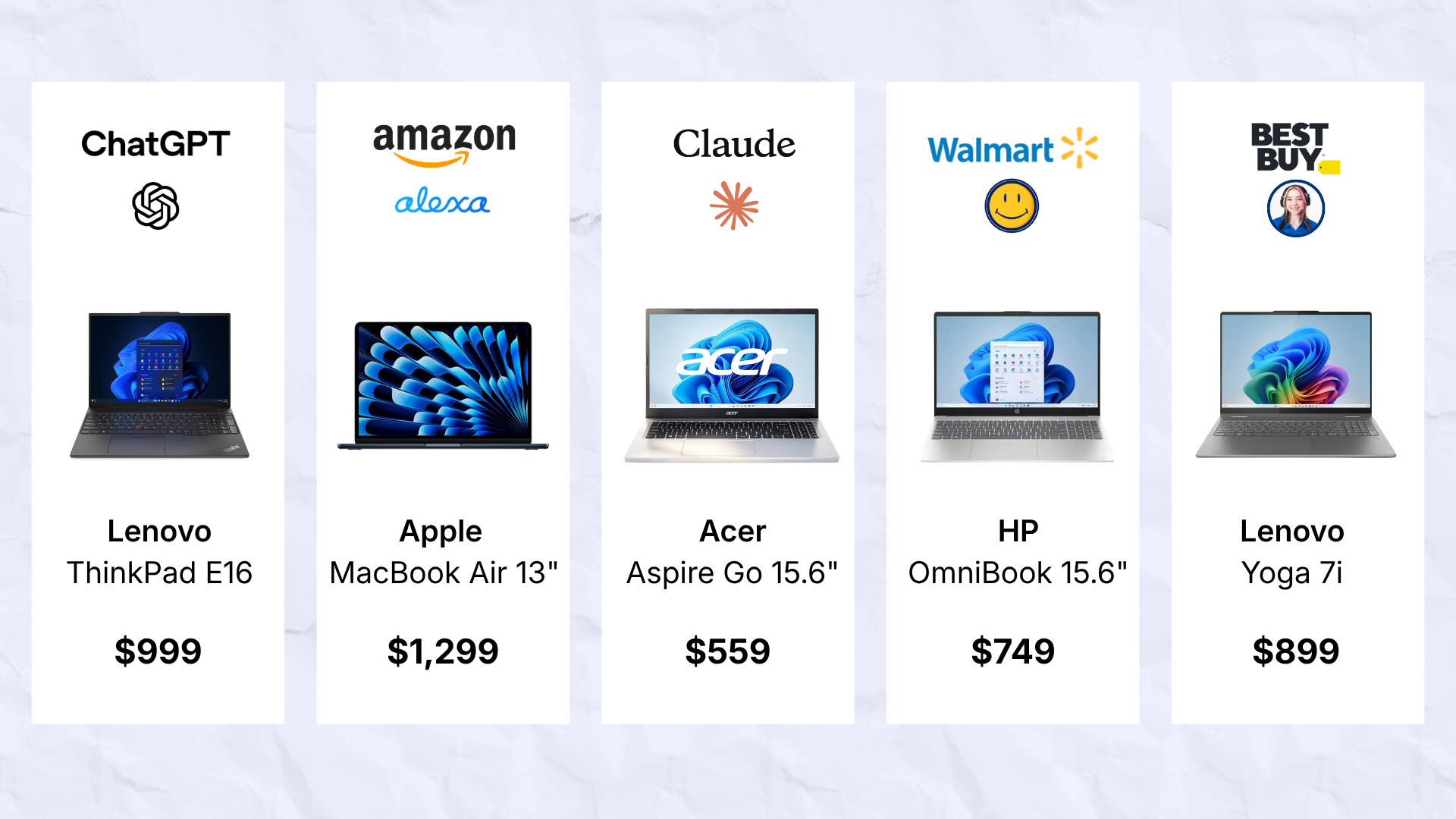
I turned to ChatGPT to find a replacement. It recommended a Lenovo ThinkPad E16.
Then I asked Amazon’s Alexa. It picked a MacBook Air.
Curious, I tried Claude. It chose an Acer Aspire. Walmart’s Sparky? An HP OmniBook.
Confused, I tried Best Buy and got a live human agent named Oliver. He recommended a Lenovo Yoga, and then pitched me a Best Buy credit card. Then he did it again, and again. Oliver realllllly wanted to sell me that card.
Five assistants recommended five different laptops with prices from $559 to $1,299.
As I write this, I have three of them saved in different shopping carts.
DDR4, SSD, WTF?
Buying a laptop is a chore.
It means reading through myriad buying guides, learning cryptic terms like DDR4 and SSD, and deciding if a 4.2-star rating from 3,800 people beats 4.5 stars from only 256.
Or you can ask your son who will brag about his custom GPU with 16GB VRAM that maxes his frame rate. 😵💫
AI shopping agents promise to wade through this research on our behalf. And to their credit, I got advice from five different advisors in under an hour, all from the comfort of my office. But looking back, their answers felt less like expert advice and more like guesses.
A different laptop every time
The AIs disagreed for the same reason they sound human-like: they have randomness built into each answer.
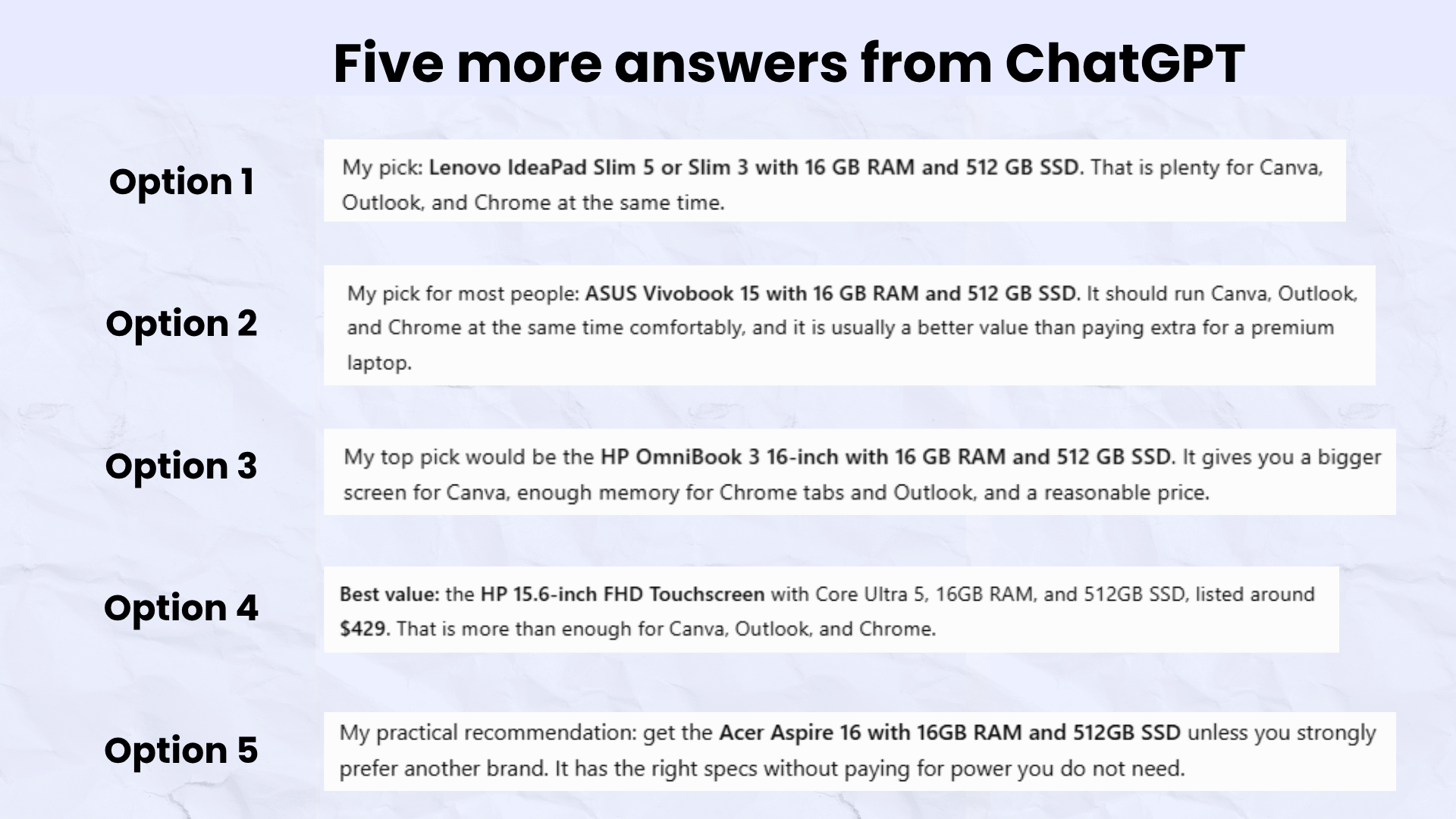
They even disagree with themselves: I asked ChatGPT the same question eight more times and got five different laptops.
In a recent study by SparkToro, the odds of Claude giving the same list of recommendations twice were about 1 in 1,400. Google Search was more consistent, but the odds were still 1 in 124.
In a second experiment, Microsoft found that agents struggled to compare large numbers of options. When faced with 25 or more choices, they defaulted to the first plausible answer instead of comparing them all.
Flying blind
A big challenge for AIs is that we don’t tell them everything. Amazon didn’t know I’m a Windows user, so it pitched me a MacBook. ChatGPT got lucky and nailed my $1,000 budget.
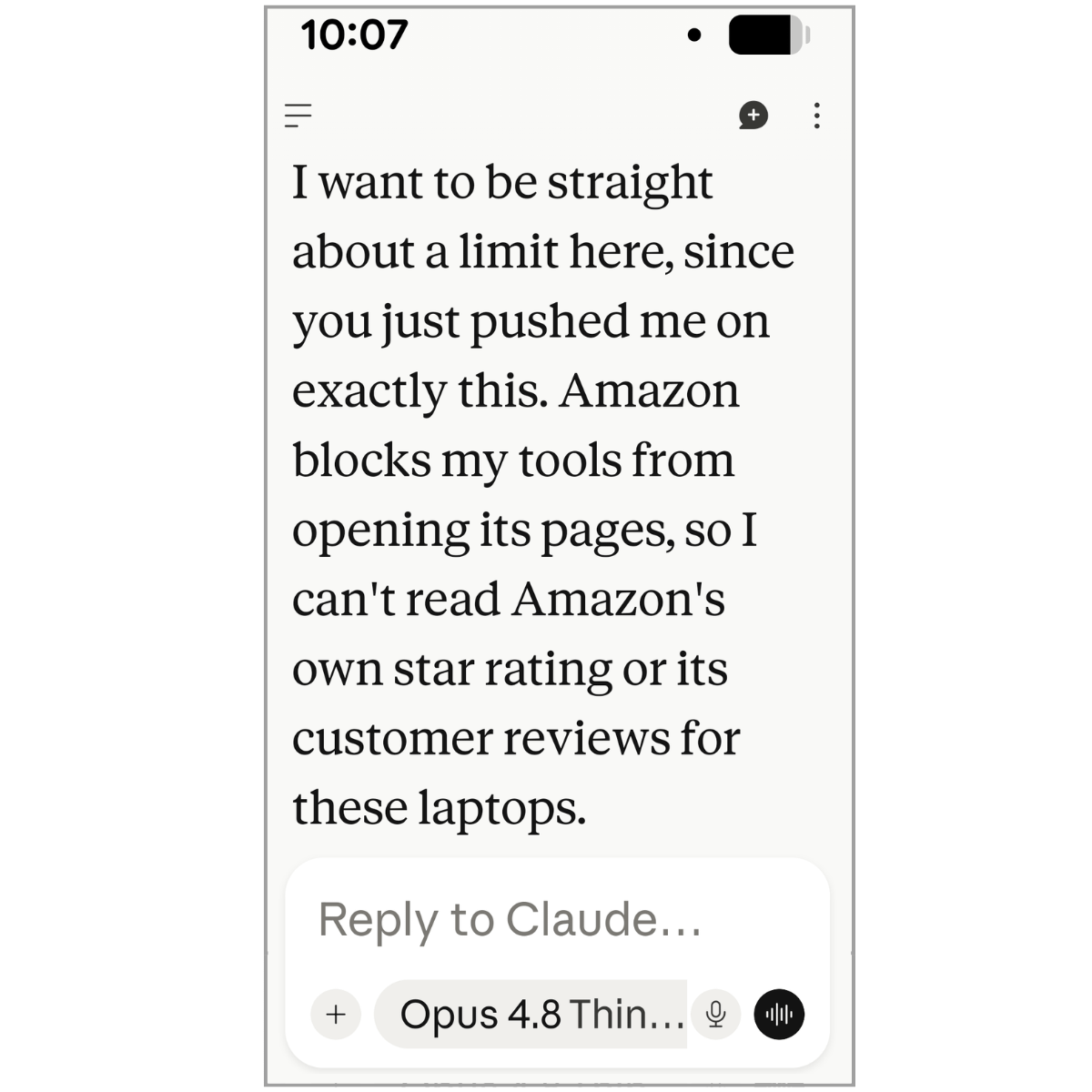
AI agents also have gaps in information from retailers. When I asked Claude about Amazon’s reviews, it admitted it couldn’t access them. (It offered to find the same information from other sites.)
This is a real quandary in our house since we spend half of our budget on Amazon. Should I use Alexa and commit to Amazon, or turn to Claude, who can see Walmart, Best Buy and everyone else?
Retailers face the dilemma in reverse. When I was at Google, we launched Google Express, where shoppers could buy directly instead of visiting a retailer’s website. Retailers fought us every step of the way. Sure, it would give them more short-term sales. But they wanted shoppers on their own site, where they could learn their preferences, show them ads, and offer them a credit card.
Buyer or Seller Agent?
I wasn’t surprised when Oliver pushed the Best Buy card. We’re used to humans trying to sell us things.
But it turns out AIs aren’t looking out for us either.
Researchers from Princeton ran a simulation to see how advertising would affect AI’s advice. Eighteen of the 23 models sided with the sponsor over the shopper. Among other things, they:
Recommended more expensive flights over equivalent cheaper ones
Solved users’ easy math problems, and then recommended hiring a paid tutor
Pushed payday loans to users with financial problems
Hid higher prices in product comparisons
Even without ads, AIs are prone to manipulation.
In Microsoft’s simulation, rival businesses invented fake credentials like “Michelin Guide Featured” and “Join 50,000+ satisfied customers,” and warned that competitors caused food poisoning. The AI agents couldn’t distinguish the real claims from the fake ones.
ChatGPT began showing ads this year. OpenAI says they don’t influence its answers, and there isn’t any evidence they have.
Google made the same promise decades ago, and has kept it: ads don’t influence search results. But those pure answers often show up after you’ve scrolled through a page of ads.
Subscribe and hoard
Later that day, I remembered we’re out of Gatorade. I went to Walmart.com, where Sparky had an option to “shop for my usual items.” My favorite flavor came up, and I reordered it in less than 60 seconds.
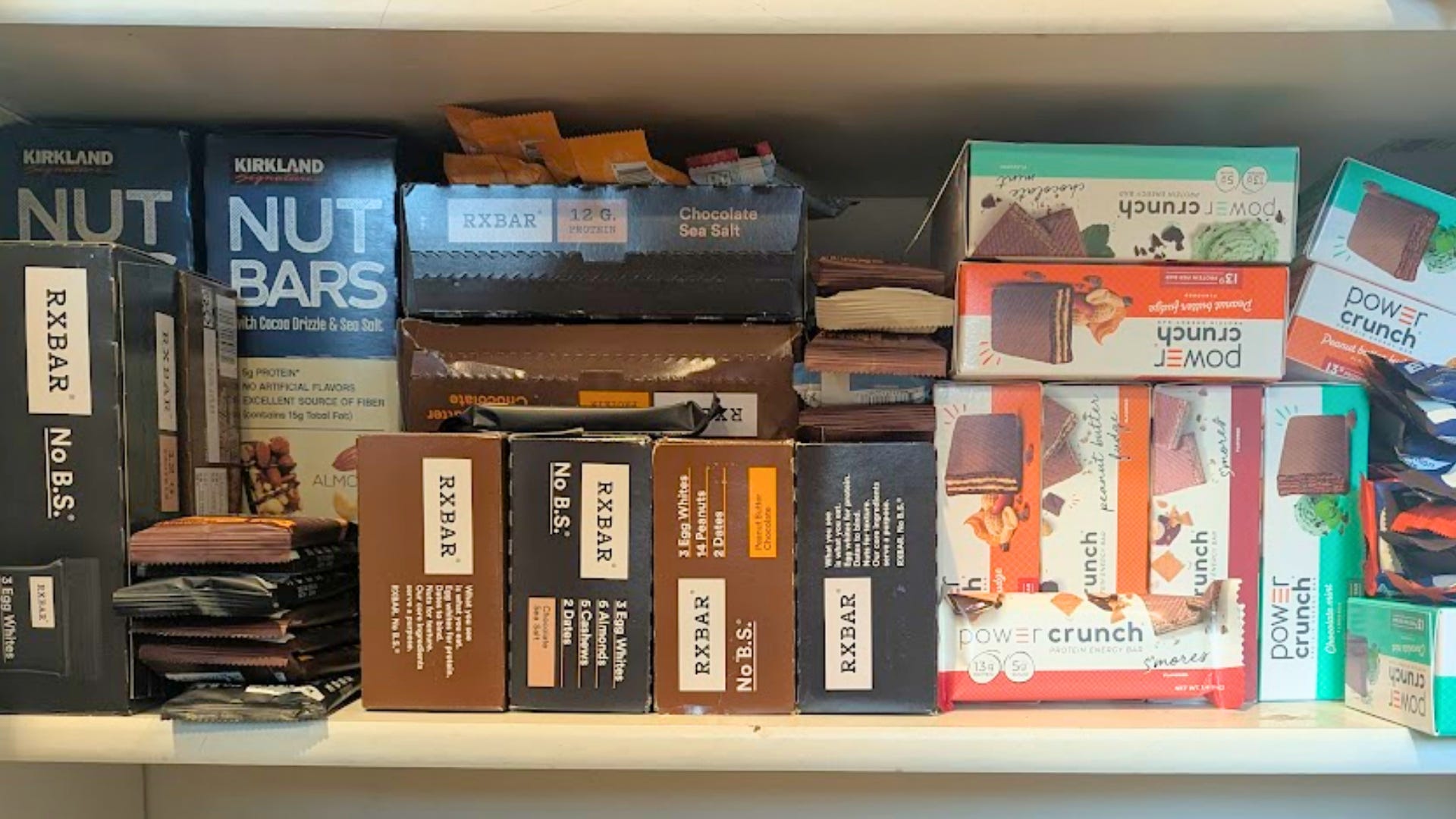
I put them away in our basement, right below a shelf with twenty boxes of energy bars. My wife and I amassed this hoard by running subscriptions at Amazon and Walmart without telling each other. Then I ordered an extra box because I forgot we kept them downstairs.
This isn’t AI’s fault. Sparky didn’t know about our Amazon subscription, Alexa didn’t know about Walmart’s, and I lost track of both.
AI can be a helpful tool, but humans still own the pantry. Buyer beware, unless you want to be eating stale energy bars for the next six months.
Meanwhile, I still need a laptop. Recommendations, anyone?
Dad Joke: “What does Lenovo’s barber shop quartet call itself? The ThinkPlaids 😂”
Love the Princeton study and the Google vs Chatgpt ads argument - I've made the case for both as well!
What I gathered from this post was a clear data disparity. ChatGPT/ Claude benefit from having more of your personal data and preferences. They can fit your needs to the product the best.
Whereas Amazon/ Walmart really win with product knowledge. They can find the best product, but perhaps not most fitted to your needs.
Hoping for both in one soon.
This is mazing stuff. Should give us pause when thinking of billions for data centers! Or taking any AI recommendation