


Last week I replaced myself with an AI avatar in a video lecture and challenged my students to spot it. Fewer than half of them could.
A third of my lectures are pre-recorded, and honestly, watching videos about AI governance is pretty boring. I sprinkle in blooper videos, AI-generated music, and superhero versions of my students to keep things interesting.
The AI avatar started as another Easter egg. But it sparked a discussion about where and when AI should show up in my classroom.
“That’s not what I’m paying for!”
Making my avatar was a piece of cake. I uploaded a photo to an AI video site called HeyGen. For $39 a month, it built a digital twin virtually indistinguishable from the real me.
I’m not a natural on camera. I over-explain some things and forget others. I stutter, pause, and say “um” way too often. It takes a ton of retakes to produce a version good enough to publish. My avatar nailed the script the first time, and its lecture was the highest quality in my entire course.
Studies find no difference in learning between AI and human videos, so I was eager to hear how my students felt.
Many didn’t mind: some watched at 1.5x speed, others on their phone or podcast-style. They cared about the content, and didn’t sweat the details.
But others felt cheated. In a class devoted to wrestling with AI and business, turning the content over to AI was backwards. One student said, “That’s not what I’m paying for!”
Some even liked catching my mistakes. The “ums” and stutters made things feel real. Lucky for them, my avatar didn’t tell any dad jokes. 🤔
Everyone agreed that AI videos should be disclosed and live lectures should always be led by humans.
Playing favorites
I’m a crappy grader. I try, I really do! But I get distracted and wear down over time. Even with breaks, it’s almost impossible to approach essay #29 with the same fresh eyes as #1.
I’m not alone. Researchers at the University of Michigan found that students with surnames later in the alphabet got lower grades and harsher feedback from teachers grading in alphabetical order. When teachers started with the letter Z, the effect reversed itself.
AI ought to be a perfect grader. It doesn’t lose focus or get tired, and can read 30 essays in a single pass. So I gave it a try.
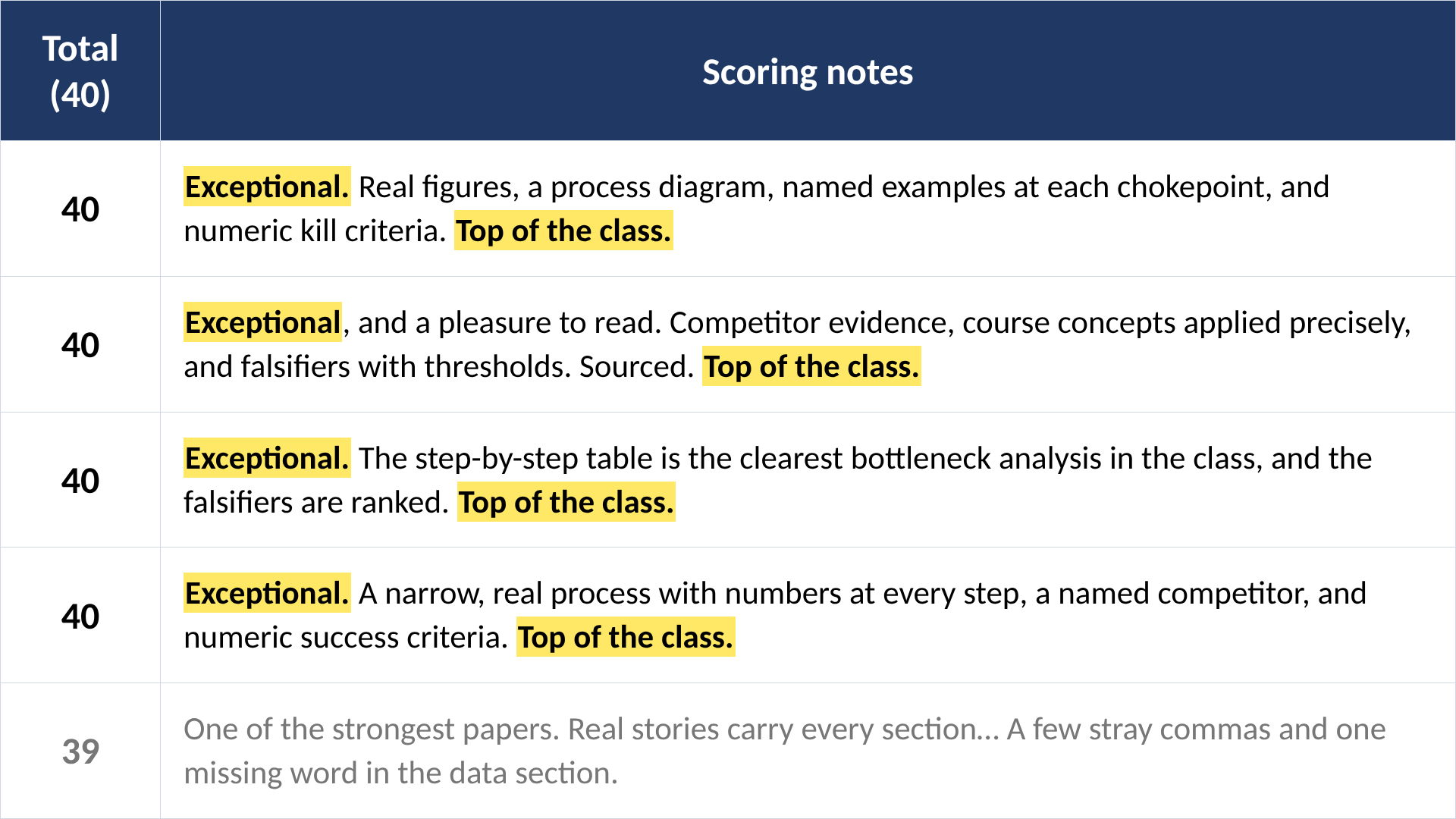
I anonymized the essays and had Claude Opus score them*. It spotted three papers to regrade: two that I’d scored too harshly and one where I was too lenient.
But it gushed over four others, calling them “Exceptional” and “Top of the class.” Wanna guess what those essays had in common? Yep, they all looked like Claude wrote them.
Researchers call this effect self-preference bias: AI evaluators tend to prefer their own writing.
My students were torn about AI grading. Some valued a human who knew them; others preferred an anonymous AI. They all liked the idea of getting near-immediate AI feedback instead of waiting on a slow human.
I still use AI as a second opinion to make sure I’m scoring fairly. We both have blind spots. Mine is fatigue and ADD. AI’s is…itself.
*Note: Student privacy is serious business, so I used UW’s secure tools on anonymized essays.
AI ate my homework
Before ChatGPT, a perfectly formatted essay with footnotes signaled excellence and attention to detail. Today, it often means the student used a chatbot.
I want students to use AI; I teach AI, after all! But I also want them to learn, and multiple studies [1,2,3] show that students who offload writing to AI learn less.
Today’s teachers are in a quandary: Expecting Claude-level homework quality rewards students for offloading to AI, while ignoring it lowers the bar for everyone. For my next class, I’m dropping my ‘professionalism’ grade and putting more weight on students’ arguments.
Some teachers are going further and ditching traditional homework in favor of bluebooks, oral presentations, and in-class exams. Others are experimenting with interactive case studies and simulations that can’t be done in one shot.
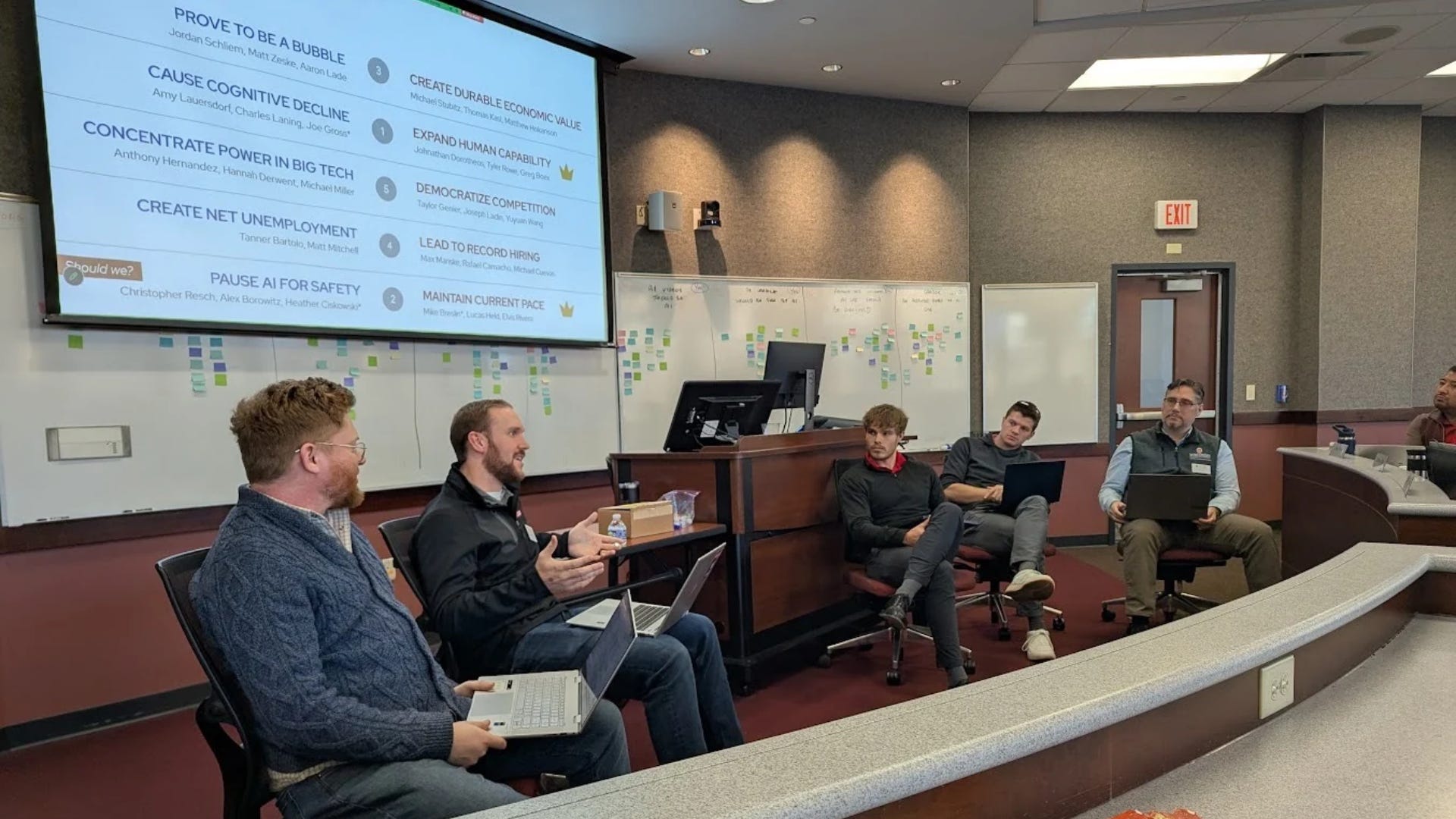
I’m trying something similar: the highlight of my course is a series of debates over topics like “should we pause AI development?” and “will AI concentrate power in big tech or democratize competition?”
Live debates and presentations take a quarter of my class time, but they bring AI to life and give students practice thinking on their feet.
Training my replacement? Not yet
After watching my avatar, one student asked me how I felt about training my replacement. It’s a fair question. Teaching with AI means coming to terms with the fact that it’s a better lecturer than I am, a faster grader than I am, and a better writer than most of my students.
This is unsettling, but teaching is a lot more than lecturing and grading.
Being a teacher means tailoring content to my students. Knowing when to push or cut off a class discussion. Giving feedback that challenges them to go further. And deciding what’s important when AI changes every few months.
My AI avatar can give a great lecture. But it doesn’t know when to plant a blooper reel.
Dad Joke: What does Anthropic call its grading approach? The Claude Curve.
Traditional educational institutions are legacy systems, and curriculum adoption has struggled to keep pace with technological change for decades. By the time some technology courses are introduced, the material is already approaching obsolescence.
LLMs have dramatically accelerated this problem. A curriculum that was current at the beginning of a semester can be outdated by midterms.
Teaching students about these technologies without actively incorporating them into the learning process risks wasting both their time and money.
We need far more model-assisted learning, particularly around evolving capabilities, enterprise adoption challenges, governance, and system architecture. Students need to learn how to evaluate these systems, not simply memorize what they could do six months ago.
I'd also argue that rhetoric, composition, and technical writing deserve renewed emphasis. Strong writing develops structured reasoning, improves prompting, and, perhaps more importantly, equips students to comprehend increasingly sophisticated technical material.
The objective shouldn't be teaching students to compete with machines at producing polished assignments. It should be developing the intellectual capacity to question, evaluate, and govern what those machines produce.
Technology changes faster than curriculum. Critical thinking, clear communication, and sound judgment are what allow students to keep up.
And to those students who felt ripped off because their professor used an AI avatar: Welcome to the real world. You're learning one of the most important lessons in technology today. The tools are changing, the economics are changing, and the expectations are changing. Learning to adapt is part of the education.