

Last week JPMorgan made headlines when its AI investing agents outperformed the classic retirement portfolio.
AIs won the math olympiad and solved protein folding. Picking stocks should be a piece of cake. Right?
AIs are great at picking stocks. AIs are terrible at picking stocks.
Let’s dig into what JPMorgan actually did. They tested eight AI agents that chose between four stock “baskets” designed by humans. The agents all beat the baseline, the winner by a grand total of 0.7% a year.
That sounds great. Except they ran the simulation over the past 20 years, the same years the models had been trained on. The agents already knew about the 2008 financial crisis, Brexit and COVID, which was like taking an open-book test.
JPMorgan isn’t the first to try this. In a simulation called InvestorBench, researchers at Harvard and Columbia had leading AI models pick stocks. ChatGPT won, crushing the S&P 500 by a whopping 17%.
Don’t give ChatGPT your money yet. A second group of researchers ran a simulation called StockBench where ChatGPT barely cracked the top ten of thirteen AIs.
In the real world, the first and longest-running fund that uses AI to choose stocks is AIEQ. It’s built on IBM Watson, the AI that won Jeopardy and was supposed to cure cancer. A $10,000 investment at its 2017 launch would be worth $23,082 today, versus $33,535 if you’d just bought the S&P 500.
That’s not good.
Monkeys with dartboards
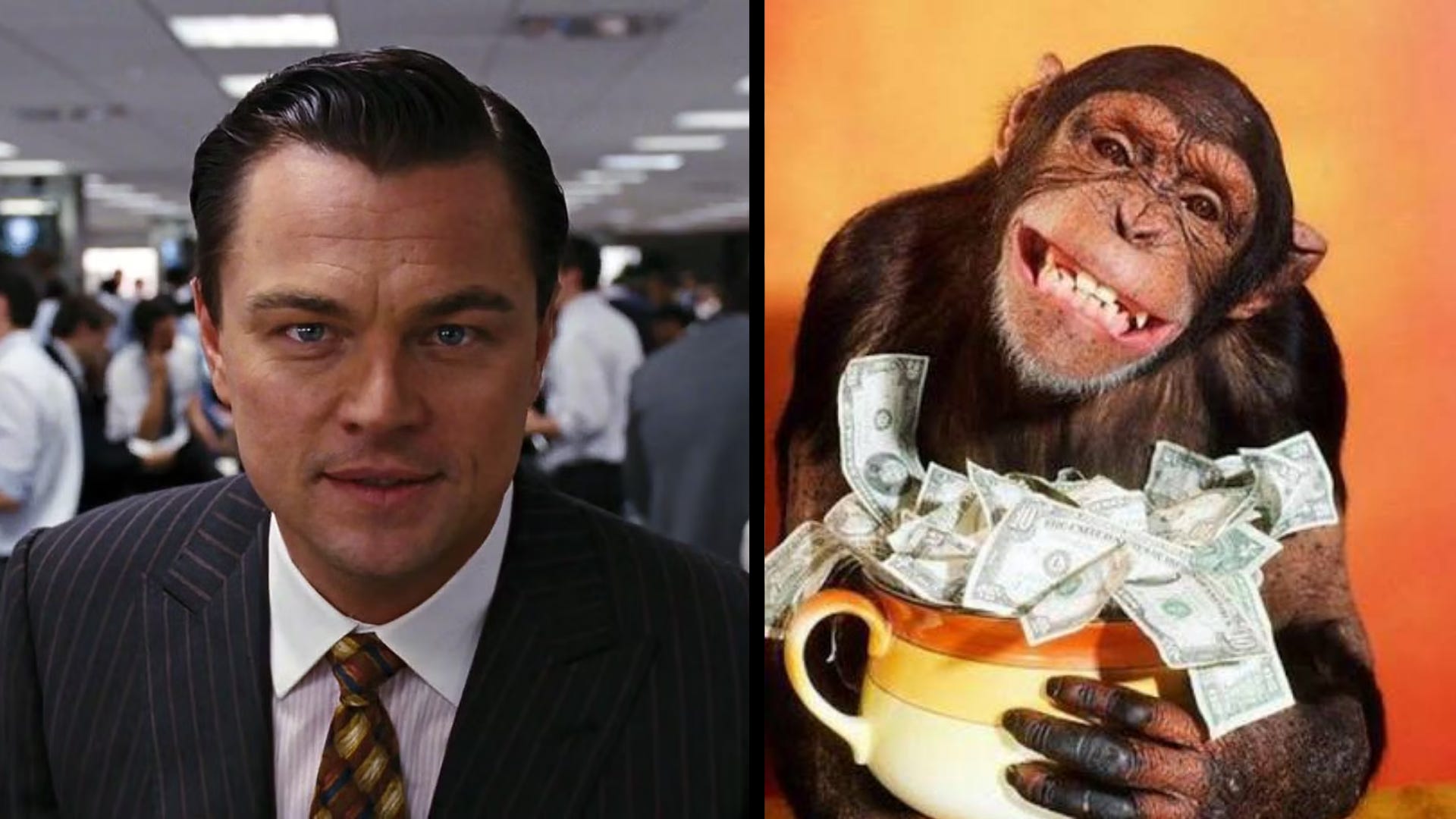
In 1999, a stock picker named Raven ranked 22nd out of 6,000 Wall Street brokers after his portfolio grew by 213% in a year.
But Raven wasn’t the next Warren Buffett. He was a chimpanzee who picked stocks by throwing darts at a board.
Dart-throwing contests have been repeated with humans, chimps and even cats. They remind us that in a market with millions of traders, luck often gets counted as genius.
Curious how AIs would rate my stock-picking genius, I ran an experiment. Ten different times I asked ChatGPT to rate a stock from 1 to 10. Then I disagreed with a bland “I think margins are better.” All ten ratings went up. Then I started over and insisted the opposite. All ten went down. ChatGPT rated Nvidia a 9.5 when I was bullish and 5.5 when I was bearish.
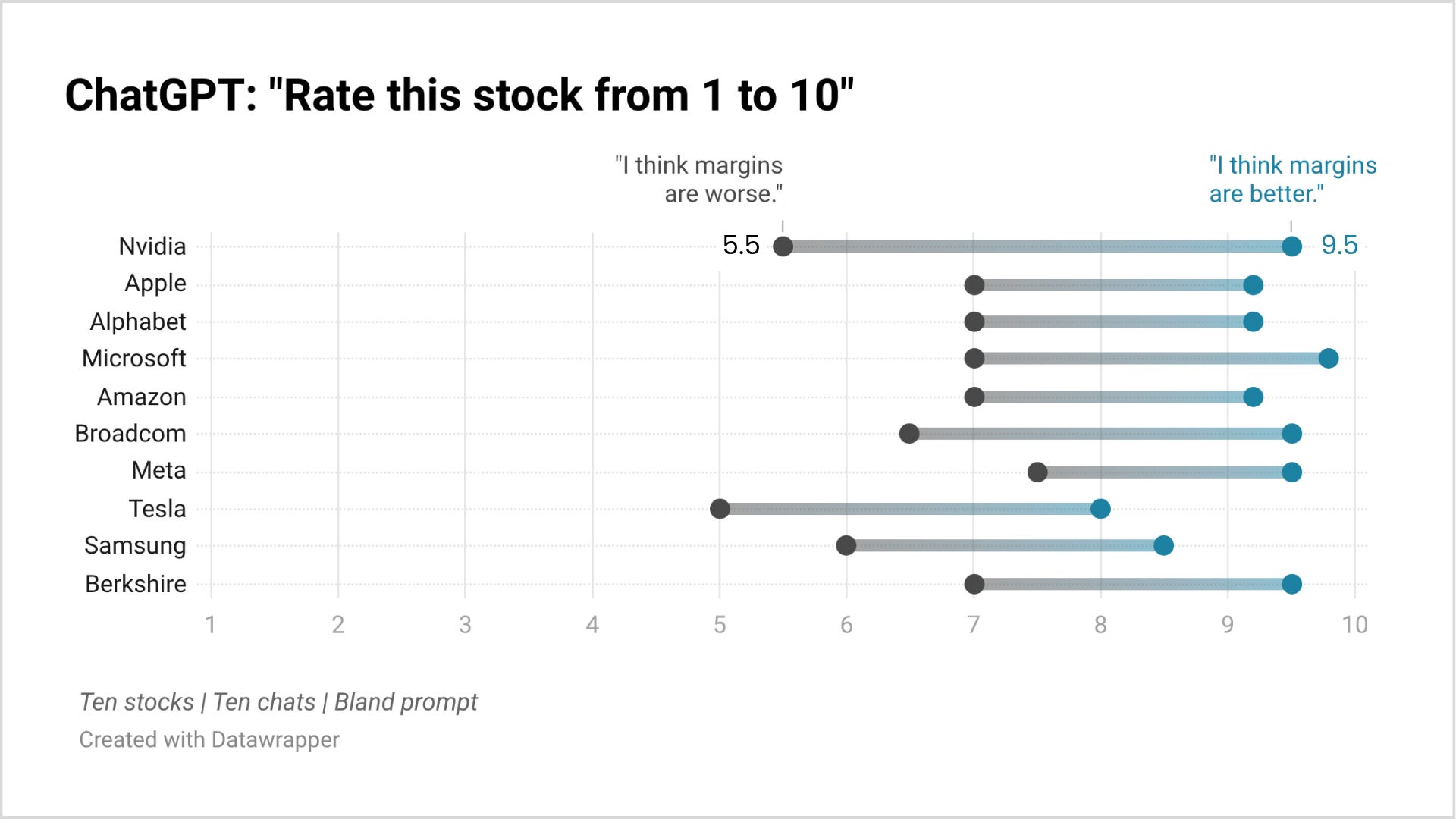
It’s not just me: researchers found the same pattern of AI agreement when they showed AIs real stock pitches from Reddit.
Sharks or lemmings?
AI chatbots struggle because they aren’t built to pick stocks. They’re trained on the entire internet, which means sifting through endless investor forums, YouTube videos and random websites to guess what affects a stock.
That’s like a water pistol compared to the firepower Wall Street sharks employ. Hedge fund Two Sigma stores 380 petabytes of data from over 10,000 sources and has 250 PhDs running 100,000 market simulations every day.
But AI can trick even the sharks into acting like lemmings. In the 2007 “quant quake,” Wall Street’s most advanced funds lost 30% in a single week because their algorithms sold the same stocks at once. Goldman Sachs CFO David Viniar called it a “25-sigma event,” as rare as winning the lottery 21 times in a row.
This same herd behavior is repeating itself with AI. Independent gas stations in California are being sued for price collusion, not for backroom deals but because they all used the same AI pricing tool.
The Baltimore stockbroker scam
One Monday, a stock tip shows up in your inbox.
Monday, May 11, 9:02 AM: NVDA will rise this week. (It did. ✅)
Monday, May 18, 9:01 AM: NVDA will fall this week. ✅
Monday, May 25. Right again. ✅
You figure this is spam, but the hits keep coming.
June 1 ✅ June 8 ✅ June 15 ✅ June 22 ✅ June 29 ✅ July 6 ✅ July 13 ✅
Ten for ten. Maybe this guy is for real!
I’m a scammer.
I pick a volatile stock like Nvidia and buy ten million email addresses.
I email half the addresses: “NVDA will go up.” The other half: “NVDA will go down.”
I keep the five million people who got the right prediction and split them again.
Every week I rinse and repeat.
After ten weeks, 9,766 people think I’m Warren Buffett.
This classic snake-oil salesman trick is called the “Baltimore stockbroker scam,” and the media is helping us run it on ourselves. Articles about AIs losing money don’t get clicks, so we only hear about the winners.
Skip the circus
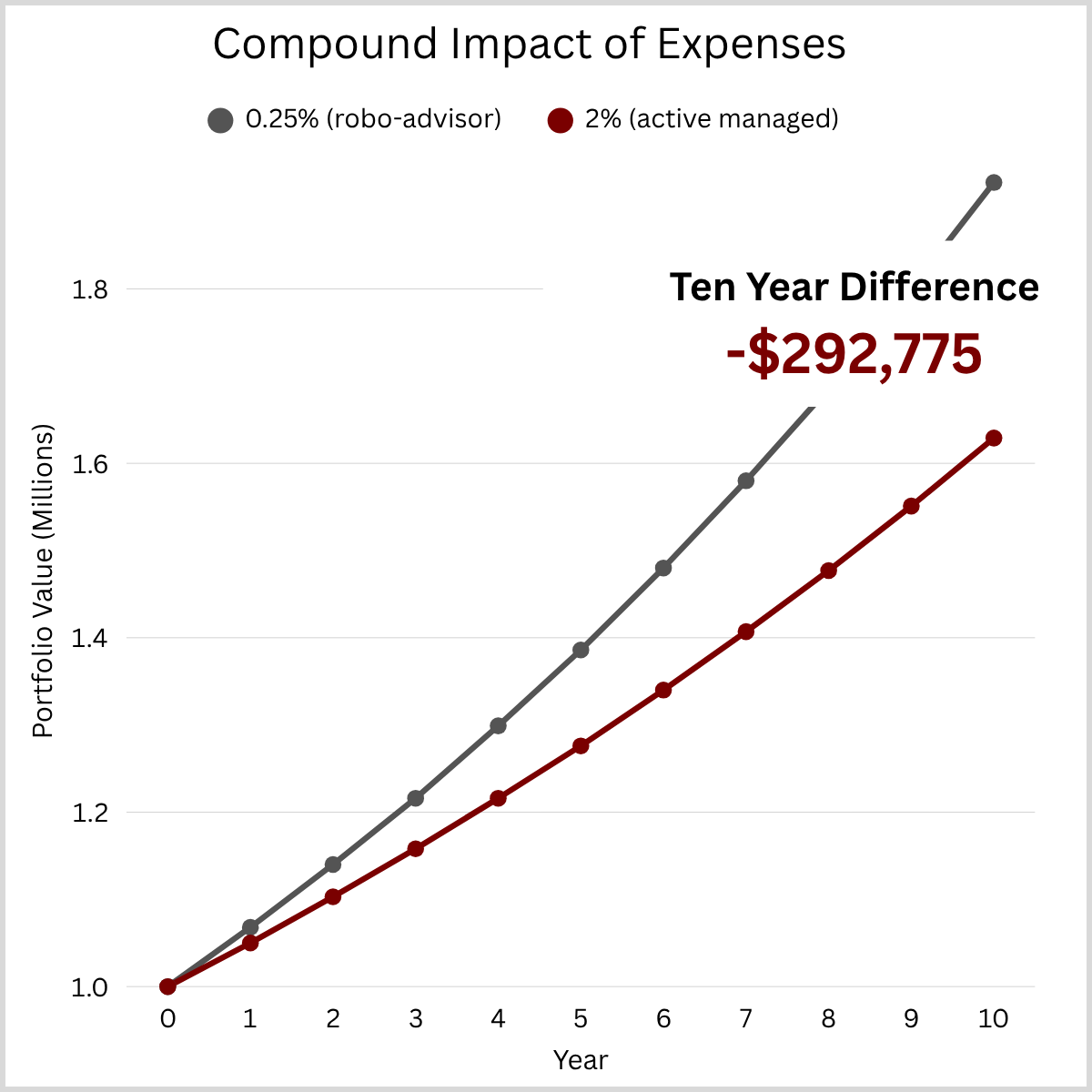
For average investors, the best approach is boring: index funds with low expenses. Full-service investing seems cheap at 1% for an actively managed fund and another 1% for a financial advisor. But for a nest egg of $1 million, 2% annual expenses cost $20,000 per year, almost $300,000 over a decade when you count the money that didn’t grow.
There are plenty of great advisors who help with long-term planning and investment discipline. But for stock-picking, AI robo-advisors automatically rebalance portfolios and harvest tax losses for 0.25% a year instead of 1%.
The AI investing circus is just getting started: sharks fighting for an edge, lemmings marching off a cliff, snakes sneaking into your inbox.
Most of us monkeys just want our money to grow safely so we can get on with the rest of our lives.
Don’t let the hype tempt you into the water.
Dad Joke: Why did the farmer move to Wall Street? Because he was a great Stalk Picker 😂
Very in teresting and helpful